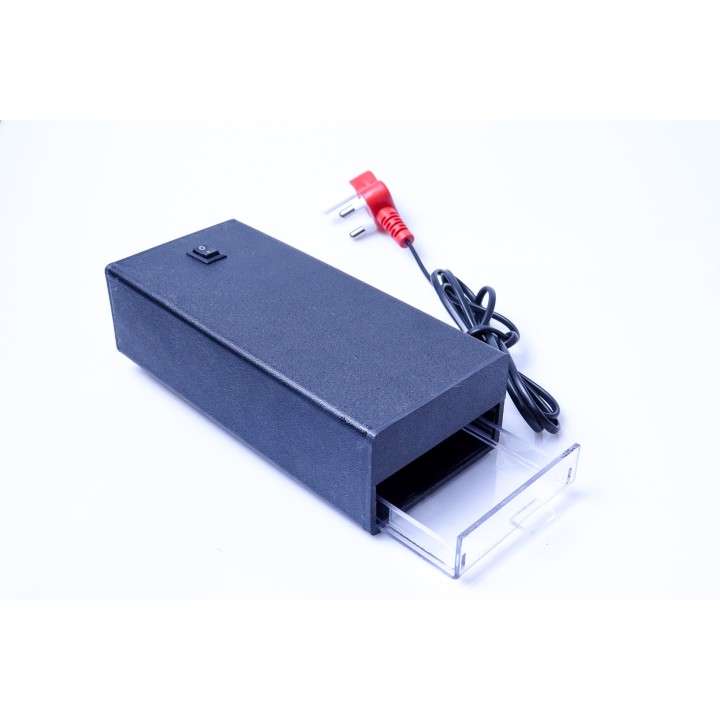
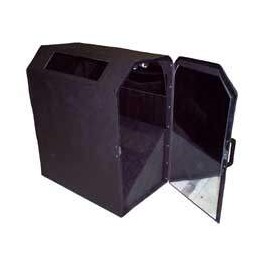
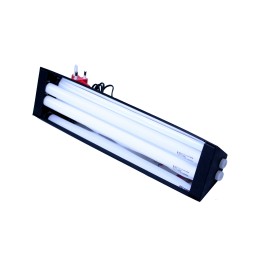
EPROM Erasure 4 Watt
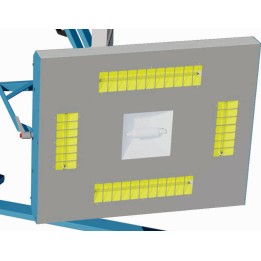
To rewrite an EPROM, you must erase it first. To erase it, you must supply a level of energy strong enough to break through the negative electrons blocking the floating gate. In a standard EPROM, this is best accomplished with UV light at a frequency of 253.7 nm. Because this particular frequency will not penetrate most plastics or glasses, each EPROM chip has a quartz window on top of it. The EPROM must be very close to the eraser's light source, within an inch or two, to work properly.
An EPROM eraser is not selective, it will erase the entire EPROM. The EPROM must be removed from the device it is in and placed under the UV light of the EPROM eraser for several minutes. An EPROM that is left under too long can become over-erased. In such a case, the EPROM's floating gates are charged to the point that they are unable to hold the electrons at all.
Working with ROMs and PROMs can be a wasteful business. Even though they are inexpensive per chip, the cost can add up over time. Erasable programmable read-only memory (EPROM) addresses this issue. EPROM chips can be rewritten many times. Erasing an EPROM requires a special tool that emits a certain frequency of ultraviolet (UV) light. EPROMs are configured using an EPROM programmer that provides voltage at specified levels depending on the type of EPROM used.
We have a grid of columns and rows. In an EPROM, the cell at each intersection has two transistors. The two transistors are separated from each other by a thin oxide layer. One of the transistors is known as the floating gate and the other as the control gate. The floating gate's only link to the row (wordline) is through the control gate. As long as this link is in place, the cell has a value of 1. To change the value to 0 requires a curious process called Fowler-Nordheim tunneling. Tunneling is used to alter the placement of electrons in the floating gate. An electrical charge, usually 10 to 13 volts, is applied to the floating gate. The charge comes from the column (bitline), enters the floating gate and drains to a ground.
This charge causes the floating-gate transistor to act like an electron gun. The excited electrons are pushed through and trapped on the other side of the thin oxide layer, giving it a negative charge. These negatively charged electrons act as a barrier between the control gate and the floating gate. A device called a cell sensor monitors the level of the charge passing through the floating gate. If the flow through the gate is greater than 50 percent of the charge, it has a value of 1. When the charge passing through drops below the 50-percent threshold, the value changes to 0. A blank EPROM has all of the gates fully open, giving each cell a value of 1.